
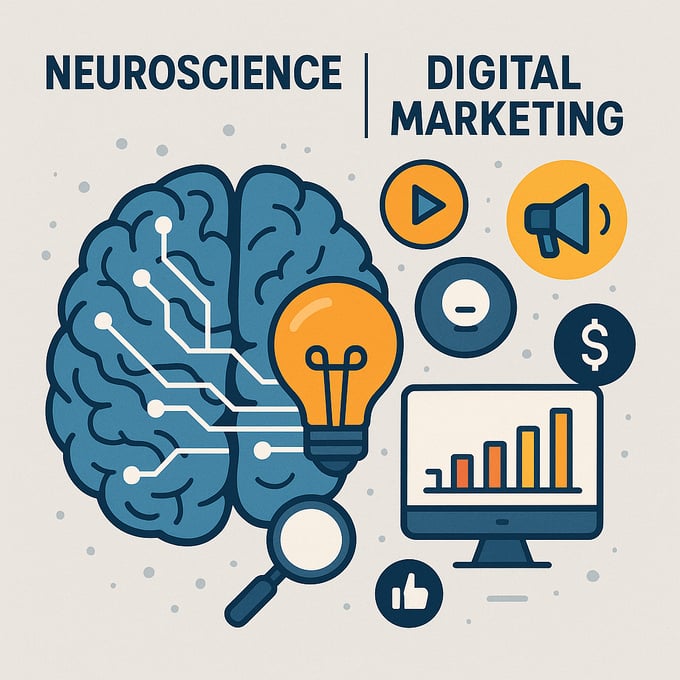
In the relentless pursuit of customer attention, marketers have long relied on intuition, experience, and simple performance metrics. But in a world where consumers are exposed to thousands of messages daily, achieving genuine connection requires a deeper understanding of why people act—and what makes them remember.
This is where Neuroscience and Digital Marketing converge.
Defining the Core Concepts
To understand this powerful convergence, we must first define the two fields:
-
Digital Marketing: This encompasses all marketing efforts that use an electronic device or the internet. It includes search engine optimization (SEO), content marketing, social media marketing, pay-per-click (PPC) advertising, and email marketing. Its goal is typically to drive measurable, specific actions like clicks, conversions, and sales.
-
Neuroscience: This is the scientific study of the nervous system, including the brain. When applied to marketing, consumer neuroscience (or neuromarketing) uses tools like EEG, eye-tracking, and implicit testing to measure unconscious responses—attention, emotion, and memory encoding—to marketing stimuli. Its goal is to uncover the subconscious drivers behind human decision-making.
By applying the principles of neuroscience to the channels of digital marketing, brands can move past simply tracking the click to understand the subconscious mental processes that truly compel an audience to engage, trust, and ultimately convert. We can engineer marketing experiences that are optimized not just for algorithms, but for the fundamental structure of the human brain.
This guide serves as your central resource for understanding this powerful convergence, introducing the core concepts and linking to detailed deep dives on how neuroscience is transforming every major facet of digital marketing, from social media to brand building.
Part 1: The Core Principle – The Science of Attention
The central challenge in digital marketing today is attention scarcity. It's not about being seen anymore; it's about being registered and processed. Neuroscience proves that most media goes unnoticed because the brain actively filters out irrelevant information before it even reaches conscious thought. This filtering mechanism is essential for survival, but it's the greatest hurdle for marketers. Data suggests that the quality of attention—how much mental focus is dedicated to an ad—is often a far better predictor of sales and effectiveness than mere reach or viewability.
Neuroscience helps marketers shift their focus from simply placing media to engineering attention by providing a map of the subconscious mind.
System 1 vs. System 2 Processing: The Two Speeds of Decision
Psychologist Daniel Kahneman famously defined two modes of thought that dictate how consumers interact with your marketing:
-
System 1 (Fast, Intuitive, Emotional): This is the automatic, rapid, and largely unconscious mode of thinking. It’s what allows us to recognize a face or slam on the brakes without deliberation. Neuroscience shows that roughly 95% of purchasing decisions are initiated here. Effective marketing must speak directly to this system through visual simplicity, clear emotional cues, and immediate relevance. If your ad takes too much effort to understand, System 1 will instantly reject it.
-
System 2 (Slow, Deliberate, Logical): This is the conscious, effortful mode of thought used for complex calculations or weighing pros and cons. While important for rationalizing a major purchase, it is easily distracted and quickly overloaded. Your marketing goal is to capture System 1 attention and use it to gently guide the consumer toward the System 2 logic that closes the sale.
For an applied example of emotional and intuitive design, explore How to Create Attention-Grabbing Ad Creative — it breaks down proven techniques that trigger automatic attention responses in your audience.
Memory Encoding: The Foundation of Brand Recall
Being seen for two seconds doesn't guarantee future sales; only memory encoding does. The brain is selective, only building strong, lasting memory structures for information that is either highly emotionally resonant or distinct from the surrounding clutter.
-
Distinctiveness: If an ad looks identical to every other ad in the feed, the brain will classify it as redundant and delete it. Creative must use surprising, unique, or visually contrasting elements to trigger memory and break the pattern of familiarity.
-
Emotion: Emotion is the brain’s shorthand for importance. Strong emotional signals—joy, curiosity, even mild surprise—act as a chemical tag, enhancing the encoding process. Campaigns must be designed not just to be seen, but to create a feeling, ensuring that the brand name and the key message are recalled precisely at the point of purchase.
💡 For a practical exploration of emotion-driven engagement, read The Science of Virality: A Neuromarketing Perspective, where we unpack why certain content triggers social sharing through dopamine and empathy.
Part 2: Applications Across the Digital Ecosystem
The true value of neuroscience lies in its practical application. By integrating these principles with performance data, brands can move from simply broadcasting a generic message to delivering a contextually relevant and emotionally optimized experience across all channels. The goal is to maximize the neural efficiency of every dollar spent.
1. Creative Performance and Synergy
Creative execution must be validated by science to ensure efficacy. The days of relying on intuition alone are gone; neuroscience provides a predictive framework for testing and designing visuals, copy, and tone that are guaranteed to capture attention and embed themselves in memory. This shift turns creative development into a targeted science.
Key Neuro-Creative Applications:
-
Visual Hierarchy: Using eye-tracking to optimize where the consumer’s gaze lands first (e.g., placing the product or CTA in the dominant visual field).
-
Color Psychology: Validating color choices and contrasts that elicit the desired emotional response or enhance visual distinctiveness.
-
Cognitive Load Reduction: Ensuring the message is understood in under two seconds to appeal to System 1 thinking.
-
Why Data and Creative Must Work Hand-in-Hand (This explores how to bridge the gap between artistic intuition and analytical performance, showing that the best creative is guided by data about the brain's processing. It details how neuro-insights validate creative hypotheses, reducing risk and boosting ROI.)
Explore The Psychology of Colour in Digital Marketing to see how colour triggers emotional associations, attention, and brand perception within milliseconds.
2. Media and Ad Effectiveness
Beyond simply bidding on reach and impressions, neuroscience guides the optimal context for ad exposure—determining when a customer is most receptive, and which environments maximize attention quality. It helps advertisers understand the mindset of the user when an ad appears, moving media buying from a volume game to a value-based strategy focused on memory encoding.
Neuroscience transforms media strategy by focusing on:
-
Receptivity Timing: Placing ads when consumers are in a state of high attention (e.g., mid-scroll on a relevant article vs. during a fast-paced game).
-
Contextual Resonance: Matching the emotional tone of the content environment with the creative message to enhance message processing and recall.
-
How Neuroscience is Reshaping TV & Digital Media Buying (Discover how neuro-insights are guiding high-impact placement strategies, ensuring media investments are optimized for memory encoding and attention quality, particularly in cross-channel campaigns.)
-
The Science Behind Programmatic Ad Placements (A deep dive into using behavioral data and psychological cues to deliver the right message at the exact moment of receptive attention. This goes beyond demographics, using context to predict the consumer's current emotional state.)
Modern neuroscience is revolutionising media planning — transforming it from a numbers game into a context and attention game.
-
Programmatic Advertising: See how programmatic goes beyond automation in Programmatic Media Buying: Why It’s More Than Just Automation.
-
Cross-Channel Integration: Learn how to connect your media ecosystem through CTV and digital in How to Integrate CTV/OTT with Digital Campaigns in Australia.
-
Audio and Context: Discover emotional resonance in voice-driven environments in A Guide to Programmatic Audio Advertising in Australia.
These insights reveal how placement, tone, and sensory context all impact memory encoding — a critical factor for ad effectiveness.
3. Customer Connection and Experience (CX)
Neuroscience empowers marketers to build deeper, more human connections by focusing on authentic personalization and understanding the psychological toll of digital bombardment. By mapping the user experience to cognitive load, brands can design interactions that feel seamless, intuitive, and rewarding.
CX elements driven by neuro-principles:
-
Social Proof Triggers: Optimizing the display of reviews, testimonials, and follower counts to leverage the brain's tendency to follow the crowd.
-
Frictionless Pathways: Minimizing the number of clicks and decisions (reducing cognitive load) required to complete a transaction or task.
-
How Neuroscience is Revolutionising Social Media Planning (Learn how to leverage rapid attention cues, social proof, and triggers related to dopamine in the brain to break through the endless scroll. It focuses on the psychological levers that drive engagement and sharing.)
-
The Neuroscience of Customer Experience (CX) in the Digital Age (Examines how cognitive load, emotional conditioning, and the psychology of satisfaction drive loyalty and conversion on digital platforms, from website navigation to app design.)
-
Personalisation with Privacy in Mind: A Strategic Approach (Explores how to deliver meaningful relevance that taps into fundamental human desires without being intrusive, balancing performance with ethical use of data. This is crucial for building consumer trust.)
Neuroscience shows that trust and empathy are the foundation of loyalty. The most effective brands deliver seamless, emotionally satisfying experiences that reduce cognitive load and build familiarity.
Influence plays a powerful role here — discover how authenticity and social proof shape neural trust patterns in How Australian Brands Are Using Influencers and Micro-Influencers.
For data-led empathy, see how AI personalisation enhances real connection in The Role of AI in Personalising Your Digital Campaigns.
4. Brand Health and Longevity
The ultimate goal of all marketing is lasting brand preference. Neuroscience is key to measuring and building that enduring emotional connection and avoiding mental burnout from over-exposure.
Building long-term brand equity requires measuring:
-
Implicit Association: Gauging the consumer's subconscious, instant connection between a brand and a key value (e.g., "quality," "speed," "fun").
-
Sentiment and Emotional Valence: Moving beyond simple "likes" and "shares" to measure the depth and positive direction of the emotional response.
-
The Emotional ROI: How Brand Resonance Leads to Business Growth
-
The Science of Digital Ad Fatigue: How to Keep Your Audience Engaged
Consumer decision-making isn’t linear — it’s a multi-touch, multi-channel journey. Neuroscience helps map which moments truly matter.
Read The Importance of Marketing Attribution in a Multi-Channel World to see how brands can measure the subconscious influence of each digital touchpoint.
If you’re targeting major metros, explore A Guide to Programmatic Advertising in Sydney, Melbourne, and Brisbane for city-specific strategies that combine data and psychology for optimal campaign performance.
Part 3: Implementing a Neuro-Driven Culture
The move toward neuro-marketing is more than just adopting new technology—it is a strategic imperative that demands a cultural and organizational shift. It requires integrating scientific tools, restructuring workflows, and fundamentally shifting how teams collaborate. By embedding a focus on the subconscious consumer experience, organizations can transform their marketing from guesswork into a precise, engineered system for superior, measurable business success.
Organizations embracing this approach are taking the following essential steps:
-
Breaking Silos for True Integration:
-
-
The Shift: Moving away from the traditional model where data teams analyze results after a campaign, and creative teams work in isolation based on subjective briefs.
-
The Action: Bringing data scientists, media buyers, and creative strategists together from the outset of the strategy development process. This ensures that creative concepts are informed by predictive behavioral insights, and media placements are designed to optimize for attention, not just reach.
-
-
Validating Hypotheses with Neuro-Tools:
-
The Shift: Replacing expensive, time-consuming A/B testing or reliance on focus groups (which measure conscious thought) with predictive, subconscious measurement.
-
The Action: Utilizing advanced neuro-tools to validate creative effectiveness before campaign launch:
-
Implicit Testing: Gauging immediate, non-conscious attitudes toward a brand or message.
-
Facial Coding: Measuring genuine, moment-by-moment emotional responses (joy, confusion, boredom) to video content.
-
Attention Mapping (Eye-Tracking): Tracking precisely where a viewer's eyes go, ensuring the key message or product is seen and processed.
-
-
-
Prioritizing Holistic Metrics:
-
The Shift: Recognizing that focusing only on short-term metrics (CPA, CTR) degrades long-term brand equity and ultimately makes future conversions more expensive.
-
The Action: Establishing a balanced dashboard that measures long-term emotional impact alongside short-term conversion performance. Key holistic metrics include:
-
Brand Recall and Salience: The speed and accuracy with which the brand comes to mind in relevant situations.
-
Emotional Resonance Score: A quantified measure of the strength and quality of the feeling generated by the creative.
-
Attention Quality: The average time the ad was actively fixated upon, not just passively viewable.
-
-
By making these operational and cultural investments, businesses can harness the most advanced science available—the science of the human brain—to gain a decisive competitive advantage.
AI is reshaping how marketers understand and influence attention, emotion, and decision-making. It’s not replacing human creativity — it’s augmenting it.
Learn how human creativity and AI synergy are changing the landscape in The Future of Marketing: How AI is Augmenting Human Creativity.
Then explore how generative AI is revolutionising search intent and discovery in Optimising for Generative AI: The Future of Digital Marketing in Australia and The Impact of Generative AI on Search Behaviour.
💬 Still curious about how AI fits into your marketing strategy? See Your Most Pressing Questions About Our AI-Powered Services Answered for transparent answers about implementation, ethics, and ROI.
The Brain and Attention: How to Create Ads That Truly Engage 🧠
Attention is the new currency of the digital age. Neuroscience reveals that the human brain, to prevent sensory overload, operates as a massive filter, sifting through an estimated 6,000 to 10,000 marketing messages daily. To cut through this noise, brands must tap into the brain’s attention networks—the primal, rapid mechanisms that decide what's worth focusing on.
The Two Systems of Attention
Attention is governed by two major systems in the brain, which marketers must address sequentially to ensure engagement:
-
Bottom-Up (Involuntary) Attention: This is the fast, subconscious system, managed by the Reticular Activating System (RAS). It scans the environment for salient stimuli (sudden changes, danger, novelty) and immediately redirects focus.
-
Goal: Capture initial, fleeting attention.
-
Neuromarketing Tool: Motion, Contrast, and Color.
-
-
Top-Down (Voluntary) Attention: This is the slow, conscious system, managed by the Prefrontal Cortex. It engages when the brain decides the stimulus is relevant, valuable, or related to a current goal.
-
Goal: Maintain focus and drive cognitive processing.
-
Neuromarketing Tool: Relevance, Emotion, and Storytelling.
-
Neuromarketing Insights Applied to Creative
To move a customer through the buyer's journey—from simply noticing the ad to acting on it—marketers should apply these insights:
| Neuromarketing Insight | Brain Mechanism Activated | Practical Application for Ad Creative |
| Emotional Triggers (Humor, Surprise, Empathy) | Limbic System (Amygdala, Hippocampus) | Activates memory and association, making the ad more memorable and increasing the perceived value of the brand. |
| Faces and Eye Contact | Fusiform Face Area (FFA) | Increases viewer engagement by up to 40%. Directly connect with the viewer using a person looking at the camera to trigger social attention mechanisms. |
| Motion and Contrast | Reticular Activating System (RAS) | Captures subconscious attention within the first 2.7 seconds. Use quick cuts, unexpected movement, or stark visual contrast in the first few frames of video or animated display ads. |
| Relatability and Conflict | Default Mode Network (DMN) | Use storytelling visuals and emotionally charged language that introduces a common pain point or problem before presenting the product as the solution. |
The Science of Virality: Why We Share What We Share 🤝
Why do some campaigns go viral while others vanish into obscurity? Virality isn’t luck—it’s biology and social psychology. When people share content, they are not just passing along information; they are engaging in a social ritual. This action activates key brain regions associated with social reward and empathy, particularly the temporoparietal junction (TPJ) (involved in perspective-taking) and the nucleus accumbens (the brain's reward center). Sharing makes us feel good, connected, and useful.
Key Neurological and Psychological Triggers for Virality
| Key Trigger | Psychological Mechanism | Strategic Application for Content |
| Emotion Beats Logic | Arousal and Valence: Content that evokes high-arousal emotions (awe, joy, surprise, or anger/anxiety) is shared more often than content that is merely interesting. | Action: Design campaigns that prioritize a strong, immediate emotional spike. High-arousal joy (positive surprise) is the most powerful viral driver. |
| Identity Affirmation | Self-Perception and Social Signaling: People share what aligns with how they want to be perceived by their social circle (e.g., smart, funny, caring, well-informed). | Action: Create content that serves as a social currency. Frame your brand's message so that sharing it makes the user look good, insightful, or reinforces their group membership. |
| Social Proof and Utility | Conformity and Value Exchange: The brain seeks safety in numbers (conformity). If content has high share counts or influencer endorsements, it reinforces its perceived value. | Action: Ensure the content offers clear utility—it solves a problem, saves money, or makes the recipient appear knowledgeable. High initial traction (paid boosting for shares/likes) is essential to trigger this mechanism. |
| Practical Value | Reciprocity: Sharing information that helps others—a tip, a discount, or a useful hack—triggers the reward associated with altruism and social bonding. | Action: Package complex information into easily digestible, actionable formats (e.g., infographics, short "life-hack" videos) that are effortless to pass along. |
The Psychology of Colour: How Design Influences Decisions 🌈
Colour doesn’t just decorate—it communicates directly to the subconscious. Different hues evoke distinct emotional and physiological responses in the brain, influencing brand perception and decision-making long before a user reads a word of copy. The brain forms a subconscious judgment about a visual within 90 seconds, and colour influences brand recognition by up to 80%.
Key Colour Associations and Strategic Use
| Colour | Psychological Association | Strategic Digital Use |
| Blue | Trust, Stability, Logic, Calm | Ideal for financial services (PayPal, Visa) or tech/B2B brands. Use in CTAs to build confidence. |
| Red | Urgency, Excitement, Passion, Danger | Used for clearance sales, "Buy Now" buttons, and food/beverage brands (Coca-Cola, YouTube). Triggers action. |
| Green | Balance, Growth, Health, Nature | Ideal for sustainability, health/wellness, or financial investment brands. Conveys safety and positivity. |
| Yellow | Optimism, Attention, Caution | Used to highlight key information or to create a cheerful, youthful feeling. Can signal a warning if overused. |
| Black | Power, Luxury, Sophistication | Used by high-end fashion and prestige brands. Conveys exclusivity and quality. |
| Orange | Energy, Friendliness, Affordability | Used to inspire playfulness and creativity. Great for "Subscribe" or friendly CTAs. |
AI and Creativity: The Future of Marketing Innovation 💡
AI isn’t replacing creativity—it’s enhancing and augmenting it.4 Neuroscience confirms that true human creativity thrives when the brain can offload routine cognitive tasks. That is precisely what AI does, freeing marketers to focus their high-level cognitive function on strategic storytelling, emotional resonance, and innovation.
The Cognitive Impact of AI Augmentation
The partnership between human and machine is highly efficient:
| Partner | Role in Creativity | Cognitive Function |
| Human Marketer | Strategy, Emotion, Ethics | Focuses on divergent thinking, defining the "why" and "feeling" of the campaign. |
| AI Tool | Generation, Optimization, Data Synthesis | Focuses on convergent thinking, exploring all possible data combinations to deliver the most efficient solution. |
-
AI Mimics Association: AI-driven tools like ChatGPT, Midjourney, and Jasper mimic the brain’s associative process—connecting disparate ideas across massive datasets to generate new, unique patterns, images, and text variations at scale.
-
Hyper-Personalization: AI enables the creation of thousands of personalized ad creatives, ensuring the colour, copy, and tone are instantly adjusted to resonate with the individual user's current emotional state or stage in the purchase funnel.
Key Insight for Tomorrow's Marketing
The best marketing of tomorrow will come from human-AI collaboration, blending emotion with data to create experiences that truly resonate. Marketers should use AI as a tool to handle the scale and speed of creation, reserving human effort for establishing the emotional core and strategic direction of the brand. This maximizes efficiency while maintaining the human touch that drives connection and virality.
The Role of AI in Personalising Your Digital Campaigns ✨
Personalisation is no longer a luxury—it’s a neurological expectation. When users encounter content that perfectly reflects their interests or past behavior, the ventromedial prefrontal cortex (vmPFC)—the area responsible for assigning value and driving goal-directed behavior—"lights up." This means personalization literally makes the brain assign a higher subjective worth to an offer, moving it from noise to signal.
How AI Elevates Personalization
AI takes personalization far beyond simple name-in-an-email tactics by leveraging sophisticated data processing capabilities to predict and react to individual intent:
-
Predictive Analytics: AI anticipates user intent by analyzing vast datasets of past behavior (clicks, scroll depth, time of day, sequential purchases). This allows marketers to serve the next, most relevant piece of content before the user even explicitly searches for it, meeting a psychological need almost instantly.
-
Dynamic Content Optimization (DCO): DCO uses AI to adjust elements within an ad (image, headline, CTA color, price) in real-time. If the AI predicts a user is motivated by value, it might dynamically display a discount. If the user is motivated by quality, it might display a feature comparison. This ensures the message is neurologically aligned with the individual's motivation.
-
Behavioural Segmentation: AI clusters users not just by demographics (age, location) but by psychological patterns—their how and why of engaging. This results in segments like "Price-Sensitive Shoppers," "Loyalty-Seeking Researchers," or "Impulse Buyers," allowing for messaging that targets specific cognitive biases.
-
🧠 Example: Netflix’s recommendation engine is a prime example; it personalizes not only the titles but even the thumbnail visuals (e.g., showing a user who prefers action films a thumbnail focused on a fight scene, even for a romantic comedy).
-
Strategic Takeaway
AI personalizes the experience at a cognitive level, minimizing the brain's effort to process the message and maximizing the perceived value of the offer. This shift from one-to-many messaging to a one-to-one dialogue is the key to breaking through digital fatigue.
Programmatic Media Buying: Why It’s More Than Just Automation 🎯
Behind every single digital ad placement lies a decision—a complex assessment of value, audience, and context—one that can now be made in milliseconds by AI-driven systems.
The Cognitive Parallel
The function of programmatic algorithms perfectly parallels a key neurological process: filtering irrelevant stimuli.
-
Brain: The Reticular Activating System (RAS) constantly filters sensory input, directing attention only to what is novel or relevant for survival.
-
Programmatic: Programmatic algorithms filter billions of ad impressions to find the precise audience segment, at the precise moment of intent, and on the precise piece of content, maximizing the likelihood of a meaningful human connection.
Neuromarketing Perspective on Programmatic Power
Programmatic buying transcends basic automation when it is combined with emotional intelligence and user context:
-
Contextual Targeting Aligned with User Moods: While targeting users based on behavior is effective, contextual targeting (placing an ad based on the content of the page) is critical. Placing an ad for a relaxing spa service on a page about stress reduction aligns the ad with the user's current emotional state and need, making the ad more resonant.
-
Psychographic Data for Resonance: Programmatic systems allow for the activation of psychographic data (values, attitudes, interests). This ensures an ad is not just seen by the right age group, but by people who share the brand’s core values, strengthening emotional ties.
-
Prioritise Brand Safety and Trust: The emotional baseline for conversion is trust. Programmatic features like brand safety and verification tools ensure ads do not appear next to inappropriate or polarizing content. Avoiding this cognitive dissonance maintains the user's positive association with the brand.
When data meets empathy, automation becomes persuasion. Programmatic is the engine that delivers the neuro-optimized creative at the optimal time and place, making the entire digital marketing ecosystem more efficient and human-centered.
The Importance of Marketing Attribution in a Multi-Channel World 🗺️
Consumers’ brains don’t think in channels—they think in journeys. The modern buying process is non-linear, involving multiple touchpoints across various channels (social, search, email, video). The central challenge for marketers is determining which of these stimuli truly activated the neural pathways that led to the decision to buy.
Neuroscience Meets Attribution
Effective marketing attribution mirrors the brain’s own complex decision-making process. The brain weighs multiple cues—logic, emotion, and social proof—before committing to a choice. Similarly, multi-channel attribution helps marketers understand:
-
Initial Attention (Awareness): Which channel created the first spark of curiosity, activating the brain’s filtering mechanisms and causing the user to stop scrolling? (Measured by First-Touch models).
-
Emotional Weight (Consideration): Which pieces of content or ads provided necessary validation, value, or emotional connection during the evaluation phase?
-
Final Action (Decision): Which touchpoint provided the necessary final motivation, clarity, or urgency to drive the final click or purchase? (Measured by Last-Touch models).
Effective Attribution Models for Strategic Insight
| Attribution Model | Strategic Function | Key Limitation |
| First-Touch | Measures initial awareness and discovery. Ideal for valuing upper-funnel, brand-building activity. | Gives zero credit to the effort required to close the sale. |
| Last-Touch | Measures final motivation and direct response. Ideal for short sales cycles or retargeting performance. | Ignores the crucial brand-building and consideration work. |
| Linear / U-Shaped | Provides a balanced view, valuing both early influence and final action. | Relies on predefined, somewhat arbitrary credit weights rather than actual performance data. |
| Data-Driven Attribution (DDA) | Reflects actual human journey complexity. Uses Machine Learning to statistically determine the true incremental value of each touchpoint based on your unique data. | Requires robust data integration and advanced analytics tools. |
🧠 Insight: By moving beyond simple single-touch models, marketers gain a clearer view of the full neurological journey, allowing them to invest in channels that are proven to activate the critical awareness and emotional validation required before the final decision is made.
The Impact of Generative AI on Search Behaviour 🤖
Generative AI is reshaping not just how we search—but why. AI-driven search environments (like Google's Search Generative Experience or Bing Copilot) are fundamentally changing the neurological contract between the user and the search engine.
From Keywords to Cognitive Assistants
-
Shifting Intent: Users now engage in conversational queries, asking complex, context-aware questions. They are looking for synthesized understanding, not just a list of links.
-
Neurological Alignment: This aligns perfectly with how the brain naturally learns: through dialogue, synthesis, and pattern recognition, rather than static retrieval. The AI acts like a cognitive assistant, summarizing the essential information and reducing the mental effort required for comprehension.
Marketing Implications: Optimizing for Meaning
For marketers, this neurological shift means the focus must move away from keyword stuffing and towards creating highly authoritative, meaningful content.
-
Optimize for E-A-T (Expertise, Authority, Trust): Since AI summarizes the most credible answers, content must be structured to demonstrate unquestionable authority. The AI must trust your content enough to cite it as a source in its generative answer.
-
Focus on Intent, Not Keywords: Content must satisfy the complete user intent behind a query. Instead of writing for a simple keyword, marketers must write content that fully addresses the curiosity and comprehension need that drove the user to ask the question conversationally.
-
The Rise of Zero-Click Content: Since the AI provides a summary, the user's initial need for awareness may be satisfied without ever clicking on a link. This forces marketers to ensure their content's value is so deep—offering unique data, proprietary tools, or expert opinion—that the user is compelled to click for the full context or action (consideration/decision).
Conclusion: Where Science Meets Storytelling
Neuroscience and digital marketing are no longer separate disciplines — they’re intertwined forces shaping human connection in the digital age. By understanding how people’s brains perceive colour, emotion, narrative, and trust, marketers can create experiences that resonate deeply and ethically.
The future of marketing belongs to those who combine data, design, and dopamine — crafting campaigns that don’t just reach audiences but reprogram their attention and memory in meaningful ways.
Key Takeaways
-
Neuroscience reveals why consumers pay attention, not just what they click.
-
Emotional design and colour psychology drive engagement.
-
AI augments creativity and personalisation at scale.
-
Attribution, automation, and AI search reflect how the brain learns and decides.
Successful organisations embed neuroscience into every level of strategy, creative, and analytics.
Before launching any neuro-informed campaign, ensure your strategy aligns with The Essential Digital Marketing Checklist for Australian Businesses.
And to see how these principles translate into measurable results, read 5 Key Insights from a Successful Australian Digital Marketing Campaign — a data-backed breakdown of what drives engagement and conversions in real-world scenarios.
Your Next Step: Convert Insights into Action 🚀
This guide provided the blueprint for success—the neurological mechanisms behind attention, emotion, and decision. But knowing the science is only half the battle. The true competitive edge lies in applying these insights at scale across your digital ecosystem.
Are you ready to move from guessing to guaranteed growth?
Take the Ultimate Step: Partner with Undivided Digital Marketing Agency

.png?width=180&height=51&name=image%202%20(2).png)